FREQUENTLY ASKED QUESTIONS

Website Shortcuts
MASTERPLAN
Enfield Public Schools & Town of Enfield Masterplan Page
RESEARCH
Research (Meeting Videos & Documents)
HOME
Home Page, Calendar, Blog & More
Make A Contribution Here:
PAC BROCHURE
.png/:/rs=w:1240,cg:true,m)

FREQUENTLY ASKED QUESTIONS (F.A.Q.S)
1. When does the grant reimbursement rate lock in?
At the time/date of the grant submission, which occurred in June 2026.
2. When does redistricting occur, why not do it now?
Redistricting will likely occur at the conclusions of Phase II of the project, will likely take place between 2032 and 2033. Currently, there is no capacity in the current schools to reconfigure from 6 to 4 schools, therefore redistricting will be conducted at the conclusion of the implementation of the preferred option.
3. What is the approximate difference in length of construction for New compared to Renovate as New?
In many cases, RNV (Renovate to New) takes at least 50% longer and often twice as long as constructing a new building. A detailed analysis has been conducted that identifies costs for renovation are equal to, or greater than, that of new construction due to the extended construction duration, escalated thereto, and related costs for phasing/logistics (temporary modulars, swing space, multi-phase moves).
4. How does the 15% incentive reimbursement work with our base reimbursement?
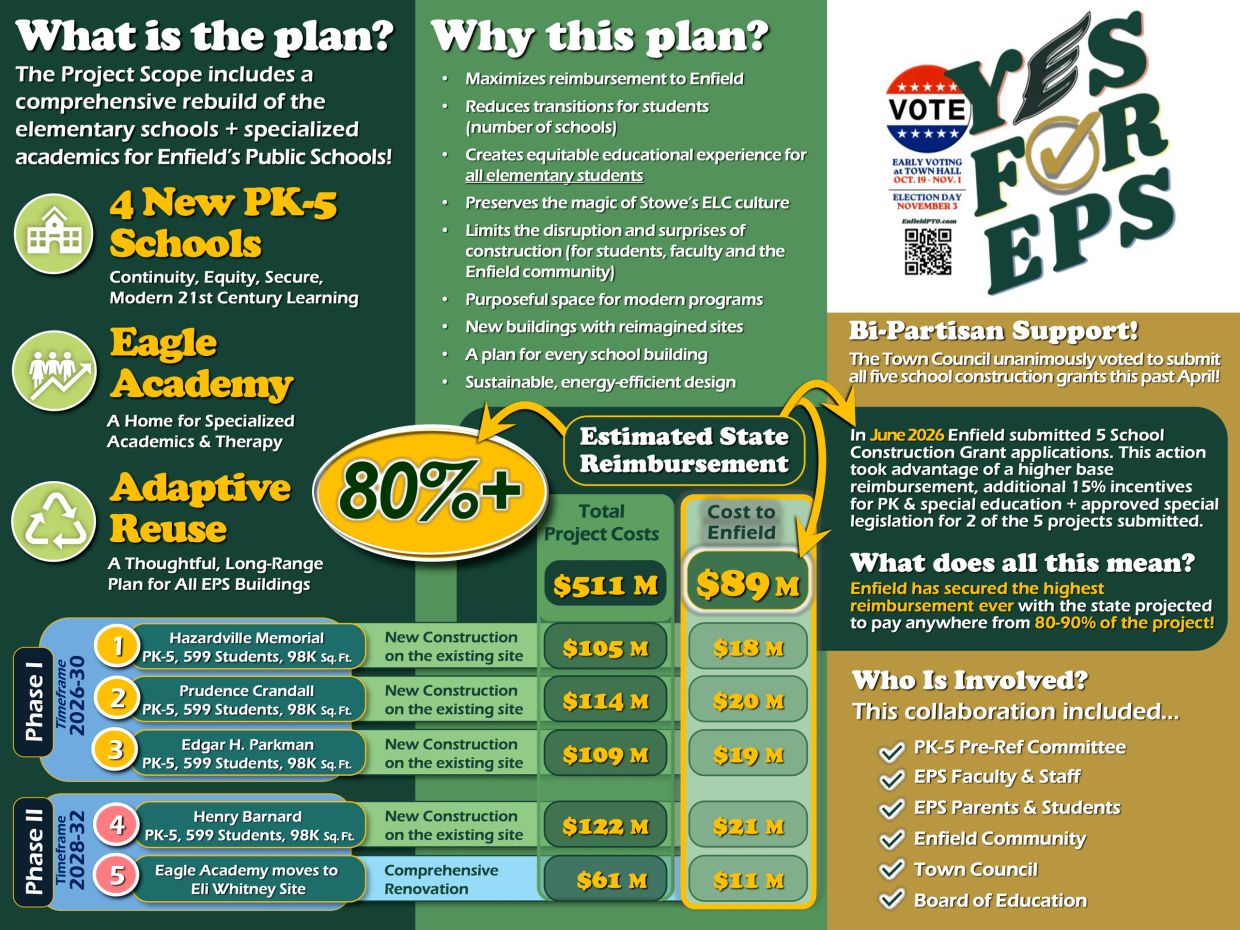
The incentives for early childhood care & education (Birth-5 years) at 15% (entire building) and specialized education +15% (S.E. program only) would be added to the base reimbursement rate. In summary we are targeting a state reimbursement rate of approximately +80%.
5. Are you trying to use existing space/land?
Yes. Our strategy is to utilize existing properties where possible versus greenfield, and to incorporate two-story facilities to preserve the existing land as much as possible.
6. What sustainable strategies are being considered?
We have included cost premiums for the possibility of geothermal wells, photovoltaic array, and enhanced, energy-efficient wall construction. The project is required to meet the CT High Performance Building Standard if a school construction grant is pursued. Items described above are considered reimbursable costs.
7. Does state school construction reimbursement rely on federal funding?
Not to our knowledge.
8. Are there key dates related to the PK/ELC incentive?
There is no information related to when and if the 15% incentive reimbursement will expire. The passage was implemented in the spring of 2025 and will likely be temporary.
9. Can you provide information on New versus Renovate as New cost/square foot?
Yes, a cost comparison based upon historical averages and industry experience has been provided on the website. See Q&A #3 above.
10. Can you speak to the durability of new construction versus renovation?
The current cost modeling includes durable building materials and systems that have life cycles in the twenty-five to thirty-year timeframe while the structure itself will last for generations.
11. Why new versus additions and renovations?
There are several reasons why the committee landed on the preferred option (New Construction). Concerns related to costs, value invested in the building, size of existing core spaces, disruption, swing space, quality of finished product, inability to address existing site, safety and traffic concerns.
12. Where can we go to review all the information pertaining to this effort?
To ensure the communication is broadly distributed to all residents, we have posted all presentations, recorded videos, and published updates to the project website: www.enfieldschools.org. There is also a project email for any questions you may have: preref@enfieldschools.org (and the EPTO PAC: www.enfieldpto.com)
13. How far along are you in the process?
EPS has been reviewing existing conditions and planning options since the initial study in 2022. Since that time EPS has held several workshops to identify both programmatic and facility conditions needs. In 2025, the town hired Tecton Architects to review prior reports, presentations, and feedback from the engagement sessions. In addition, Tecton conducted their own assessment of the facilities and program and validated or updated information from previous reports dating back to 2022. The current effort is planned to conclude Spring of 2026 and will identify a preferred plan and strategy for school construction grant application prior to the June 30, 2026, deadline.
To date, Tecton, in close coordination with EPS, the Pre-Referendum Committee, and community, has explored a variety of options from repairs, targeted upgrades, comprehensive additions and renovation, and new construction. Those options were debated at length during multiple PRC meetings, and have been narrowed to a preferred option, all based on feedback from the pre-referendum committee, district leadership, staff and teachers, as well as the community at large. The study phase will wrap up in March of 2026 with presentations to various boards. The next step is a grant submission to the state and a town-wide referendum.
14. Are you considering operable windows?
Yes, they are being contemplated and included in the comprehensive plan. This is a district-by-district choice, largely based on safety and security. There have been advancements in the mechanisms and glass that can be operable and safe. The exact details will be decided in future phases at the building committee level, but they will be factored into the costs at this phase.
15. Can you provide a summary of the expected reimbursement from the state?
Base reimbursement rate is 68.33% (New) and 70% (RNV) with incentives for early childhood care & education (Birth-5 years) at 15% (entire building) and specialized education +15% (S.E. program only). In summary we are targeting a state reimbursement rate of approximately +80%.
16. How did you arrive at the student populations?
A full demographic analysis and enrollment project was provided by MP Planning. Student populations are based upon the high projection, accounting for a multitude of factors including recent multi-unit housing developments.
17. What is the total timeframe for the project?
This is a multi-generational project plan that, if implemented as proposed, will be completed in 2033.
18. What are the costs for just fixing our building?
Targeted upgrades are likely to receive far less state reimbursement and will not address any of the programmatic needs. The age and condition of the building requires comprehensive upgrades and major building systems. The cost-benefit analysis concluded building replacement was preferred.
Update: We estimate the cost of "fixing what we have" is approx. $211M if the work started tomorrow (at today's dollars). However, if this was done over a 20-year phased plan, at a 4.25% annual increase in costs/materials/other, that amount could be $330M over 20 years.
19. How will this impact my property taxes?
If the project costs the capped amount of $89M (and the final actual costs are projected to be closer to $60M) a home with a market-value of $250K would see an average increase in taxes of approx. $240 per year over the length of the bonds.
** If the final actual costs end up at that $60M projection, that number would be approx. $162 per year on a home with a market value of $250K.
20. Are there any projects we're still paying for?
Yes, there are some past referendum projects the Town of Enfield is still paying off and ALL of them will be paid off over the course of this project's debt service schedule. So as they fall off, any additions specifically from this project will be lessened.
Again, Enfield will not be spending over the $89M in question. That is the max. However, the final cost of this project will be closer to $55-60M after additional grants and waivers are approved, and NOT the capped cost of $89M.
21. Why four elementary buildings? What happens with vacated buildings?
There are ZERO obsolete buildings in the plan. There is a plan for every facility. Learn more here: https://enfieldpto.com/masterplan
The plan is to have FOUR new Pre-K thru G5 facilities. EPS currently has SEVEN Pre-K to G5 buildings (Stowe Early Learning Center, Enfield Street, Parkman, Hazardville Memorial, Eli Whitney, Henry Barnard and Prudence Crandall).
Property Tax Impact
If the project costs the capped amount of $89M (and the final actual costs are projected to be closer to $60M) a home with a market-value of $250K would see an average increase in taxes of approx. $240 per year over the length of the bonds.
** If the final actual costs end up at that $60M projection, that number would be approx. $162 per year on a home with a market value of $250K.
The "Vote No!" Cost: $211M today ($330M over a 20-yr Plan)

Contribute to Our PAC
Make a contribution to the Enfield Planning Tomorrows Opportunities PAC to help us with our efforts. Thank you!
Sample Ballots - Enfield, CT
Copyright © 2026 Enfield Planning Tomorrows Opportunities Political Action Committee - All Rights Reserved.
EnfieldPTO Email: enfieldpto@gmail.com